


Sweet and Creamy White Chocolate Confections
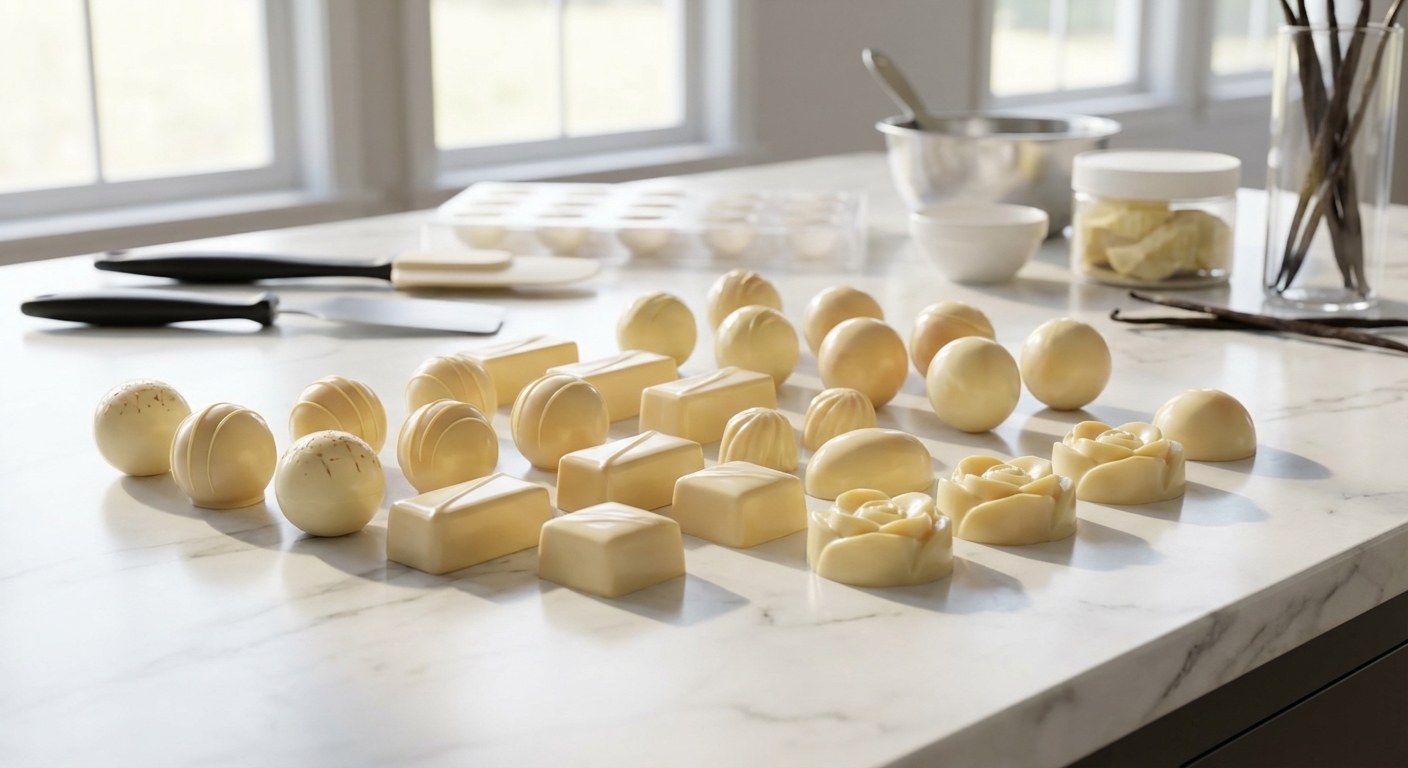
Master silky white chocolate confections by balancing cocoa butter, milk solids, and precise tempering to unlock caramel depth and flawless snap. Relish a glossy, six-month-shelf confection that elevates plated desserts and rides the $32 billion wave toward plant-based, single-origin indulgence.
Understanding White Chocolate Confections: Core Ingredients and Mastery Techniques
Master white chocolate by balancing FDA-minimum 20% cocoa butter with your choice of milk powder--whole for neutrality, cream for lush dairy depth--to control silky texture and flavor.
Key Ingredients for a Silky Mouthfeel
The silky texture that defines quality white chocolate confections comes from four core ingredients: cocoa butter, milk solids, sugar, and vanilla.
Cocoa butter -- the fat extracted directly from cocoa beans -- provides the smooth, rich mouthfeel that distinguishes fine white chocolate from commodity alternatives. [1] The FDA requires white chocolate to contain at least 20% cocoa butter and 14% total milk solids, and these proportions directly determine both texture and flavor depth. [1] Varying the milk component -- whether whole milk powder, cream powder, or buttermilk powder -- produces noticeably different results, with cream powder yielding a richer, more pronounced dairy character. [1] Lecithin is sometimes added to improve flow and consistency during production, though it remains optional and contributes minimal flavor on its own. [1]
Innovative Uses of White Chocolate Confections in Modern Desserts
Roast white chocolate for caramel depth, plate it off-center with citrus and crunch, and let asymmetry and surface detail turn a simple confection into a deliberate, modern dessert.
Creative Recipe Concepts and Presentation
White chocolate confections benefit from starting with one clear flavor direction -- roasted white chocolate, for example, develops caramel-like depth that pairs naturally with citrus or crunchy caramelized elements -- then building outward rather than introducing several strong flavors simultaneously. [4] Plating approaches like free-form arrangement and landscape-style composition suit these confections well, creating visual depth through asymmetry and height variation rather than symmetrical centering. [4] Applying the Rule of Thirds -- placing the dominant piece off-center and using garnishes to direct the eye across the plate -- produces more deliberate results, and chocolate decoration ideas can help refine the surface detail that elevates a finished piece. [4]
Production, Preservation, and Market Trends for White Chocolate Confections
Mastering precise tempering and strict ingredient ratios is the non-negotiable key to producing shelf-stable, premium white chocolate that snaps, shines, and survives its six-month shelf life in a market racing toward $32.7 billion by 2032.
Efficient Manufacturing Practices and Quality Control
White chocolate's lack of cocoa solids makes it more sensitive to temperature fluctuations than milk or dark varieties, which means precise tempering is the most consequential quality variable in production. [6] When cocoa butter crystallizes in a stable form, the finished piece achieves the characteristic snap, glossy surface, and smooth melt associated with fine white chocolate confections; without it, the result is a dull finish, gritty texture, or visible fat bloom caused by cocoa butter migrating to the surface. [6] Maintaining strict ingredient ratios -- at least 20% cocoa butter and 14% total milk solids -- is equally important, since minor deviations shift both texture and flavor before tempering even begins. [7] Manufacturers who monitor these variables consistently at each production stage are better positioned to deliver batches with uniform quality and minimal defects. [5]
Shelf Life Management, Storage Solutions, and Emerging Consumer Preferences
White chocolate's shelf life runs about six months for quality bars without inclusions -- shorter than dark varieties -- because it lacks cocoa solids and their antioxidants, leaving it vulnerable to lipid oxidation and fat bloom. [8] Storing pieces in an airtight container at 65-70 degreesF with relative humidity below 50% and away from direct light preserves both flavor and surface appearance; more detailed chocolate storage guidance covers how these same principles apply to curated collections. [8] Multi-layer barrier packaging and cold-chain temperatures maintained between 12 degreesC and 20 degreesC extend freshness further during transit, and a controlled dry environment with humidity below 65% is equally important throughout the distribution process. [8] [9] The global white chocolate market, valued at $21.6 billion in 2025 and projected to reach $32.7 billion by 2032, is being shaped by consumer interest in plant-based formulations, functional ingredients like probiotics and adaptogens, and premium single-origin varieties -- all of which carry the same environmental sensitivities and demand equally rigorous storage discipline. [10]
- White chocolate must contain ≥20% cocoa butter and ≥14% milk solids per FDA rules.
- Precise tempering determines snap, gloss, and shelf life; poor tempering causes fat bloom.
- Roasted white chocolate yields caramel depth; pair with citrus or crunchy elements.
- Store at 65-70 degreesF, <50% RH, airtight, away from light to prevent oxidation and bloom.
- Global market projected to grow from $21.6B (2025) to $32.7B (2032) on plant-based demand.
- Use off-center plating and asymmetrical height for visual depth in dessert presentations.
- https://chocolatealchemy.com/recipes/white-chocolate
- https://pastryartsmag.com/general/a-guide-to-plated-desserts/
- https://www.ice.edu/blog/contemporary-methods-plated-desserts
- https://www.unileverfoodsolutions.us/chef-training/food-service-and-hospitality-marketing/food-photography-and-food-plating-tips-and-techniques/modern-food-plating-presentation-styles.html
- https://chocolatemakingmachinery.com/process-of-white-chocolate-production/
- https://www.coracaoconfections.com/blogs/news/what-is-white-chocolate-made-of?srsltid=AfmBOorYmIzCGkbu678BPcQUxFrKSyiuFyR-EVfQd9eE742kivMUsB0M
- https://www.webstaurantstore.com/blog/5262/what-is-white-chocolate.html?srsltid=AfmBOoqnM_ykpniiggZpty2KsbrOXhtkNvsb4j2GRlLBhThUA1u8r_Bx
- https://www.tempcontrolpack.com/knowledge/cold-chain-white-chocolate-shelf-life-how-long-it-lasts-how-to-extend-it/
- https://lukerchocolate.com/en/knowledge-base/10-challenges-in-chocolate-manufacturing/
- https://www.persistencemarketresearch.com/market-research/white-chocolate-market.asp